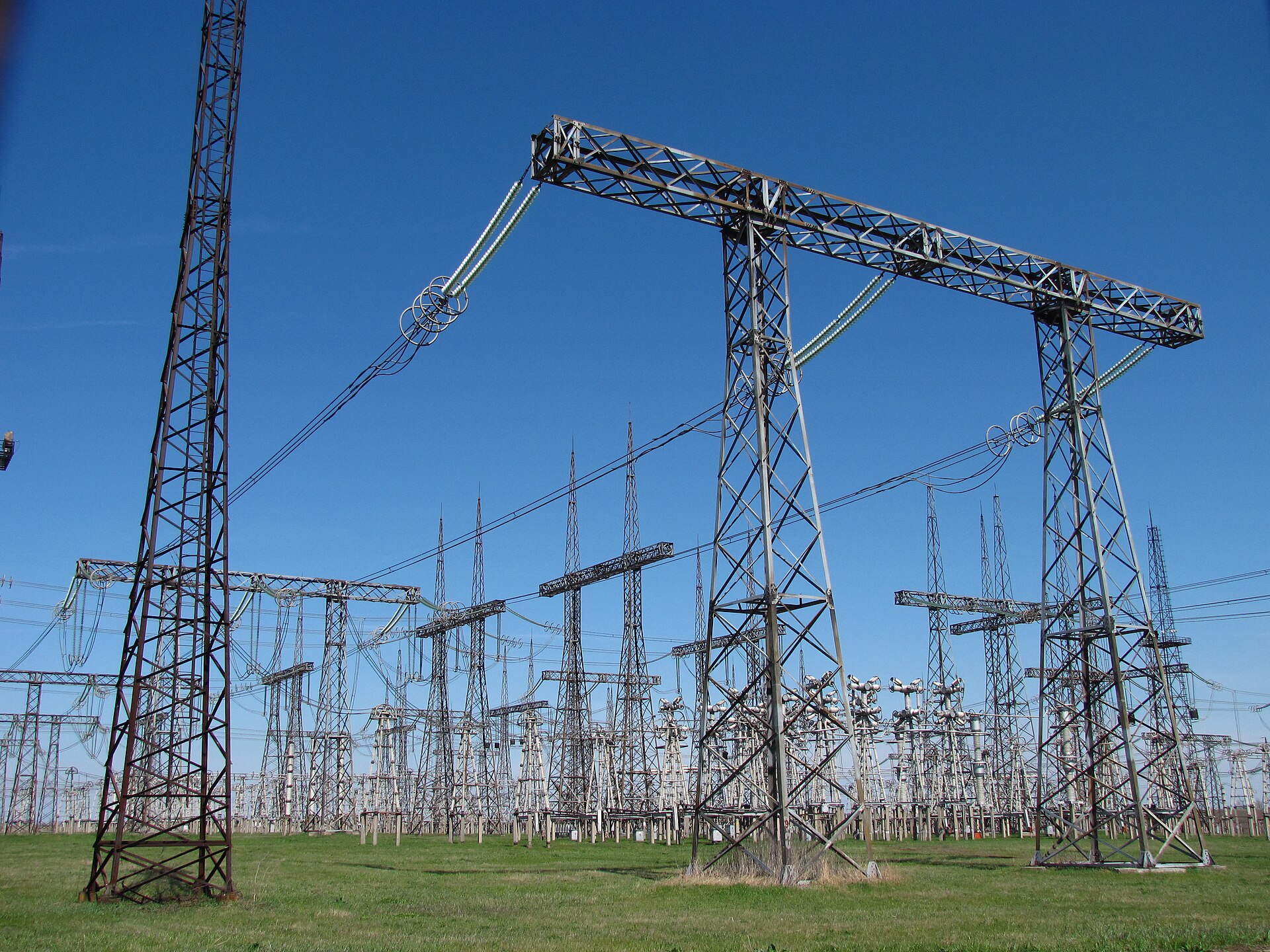
Photo: Novoklimov via Wikimedia Commons, CC0 1.0 Universal Public Domain Dedication.
Quick Answer: El Paso Electric has asked Texas regulators to approve McCloud Generation, a 551.8 million dollar, 366-megawatt natural gas facility built to serve Meta’s new El Paso data center campus during a bridge period of up to five years starting in 2027. The City of El Paso has formally opposed the application, telling the Public Utility Commission of Texas that the utility never ran a competitive procurement and never filed a rate impact study. The decision will help determine who ultimately pays for a single customer whose projected demand could reach 1 gigawatt by 2029.
What is McCloud Generation, and why is El Paso Electric building it?
McCloud Generation is not a conventional power plant in the way El Paso has understood the term for the past half century. According to El Paso Electric’s filing at the Public Utility Commission of Texas, the facility would consist of 813 modular natural gas generators sited immediately next to the data center campus it is designed to serve. Beginning in 2027, it would power that campus exclusively for an initial five-year bridge period, and it would remain physically separate from El Paso Electric’s transmission system during that window. All of the plant’s costs during the bridge period would be recovered from the data center customer under a commission-approved rate rather than spread across the utility’s general body of ratepayers.
The customer is Wurldwide LLC, a Meta subsidiary. The structure exists because the campus is arriving faster than the regional grid can be rebuilt around it. Wurldwide originally requested 220 megawatts, and the economic development rate El Paso Electric negotiated was approved on that basis. Projected demand has since risen to more than 440 megawatts by 2027 and potentially 1 gigawatt by 2029. That escalation forced El Paso Electric to amend its filing, and it is the single most important number in the entire proceeding: the utility is being asked to underwrite a load that has roughly quadrupled on paper before a megawatt of it has been delivered.
The filing also signals what happens after the bridge period. Once transmission and generation in the region have been expanded, El Paso Electric intends to ask the commission for permission to connect McCloud to the grid and to fold the cost of the plant into jurisdictional cost of service and retail rates. That sentence is the pivot point of the dispute. A plant financed entirely by one hyperscale customer is one thing; a plant that eventually lands in the rate base of a utility serving roughly 700,000 customers is another.
Key facts on McCloud Generation
| Item | Detail |
|---|---|
| Stated capital cost | 551.8 million dollars |
| Nameplate capacity | 366 megawatts |
| Technology | 813 modular natural gas generators |
| First service year | 2027 |
| Bridge period | Up to five years, serving one customer |
| Grid connection during bridge | Separate from El Paso Electric transmission |
| Cost recovery during bridge | From the data center customer, at an approved rate |
| Customer of record | Wurldwide LLC, a Meta subsidiary |
| Load at original approval | 220 megawatts |
| Load projected for 2027 | More than 440 megawatts |
| Load potentially reached by 2029 | 1 gigawatt |
How large is Meta’s El Paso campus now?
The project that triggered all of this has grown at a pace unusual even by data center standards. Meta broke ground in El Paso in October 2025, describing the site as its 29th data center and its third in Texas, with an initial phase of more than 1.5 billion dollars, roughly 100 permanent operational jobs and more than 1,800 construction workers at peak. The company said the site could scale to 1 gigawatt.
In March 2026, Meta updated that announcement. The campus would officially grow to 1 gigawatt, the investment figure rose to more than 10 billion dollars, permanent employment rose to more than 300 operational jobs, and peak construction employment rose to more than 4,000 jobs. Meta said at that point that it had projects under contract adding more than 5,000 megawatts of clean energy to the grid in Texas, and that electricity use at the El Paso site would be matched with 100 percent clean and renewable energy. The company also said it had paid for new grid infrastructure, including new transmission lines and substations, under its agreement with El Paso Electric.
What did the BlackRock venture change?
On July 28, 2026, Meta announced that the El Paso campus would be developed and owned through a venture with BlackRock, structured through Global Infrastructure Partners and HPS Investment Partners. Funds managed by BlackRock will own 80 percent of the venture and Meta will retain 20 percent. Total development cost for the buildings and the long-lived power, cooling and connectivity infrastructure is approximately 14 billion dollars.
The mechanics explain how a single El Paso site became one of the larger infrastructure financings in the state. At financial close Meta contributes land and construction-in-progress assets worth roughly 2.3 billion dollars, BlackRock contributes about 4.9 billion dollars in cash, and Meta receives a one-time distribution of roughly 1 billion dollars to align the 80-20 split. Part of BlackRock stake is funded from a 12.5 billion dollar debt financing. Meta then leases the whole campus back under an initial four-year term with four extension options, a potential 20-year term, backed by residual value guarantees with an aggregate threshold near 13 billion dollars that declines over time. The venture expects to begin bringing capacity online in 2028, with Meta as sole initial occupant and more than 2,300 workers already onsite.
Why did El Paso’s city government object?
On June 18, 2026, the City of El Paso announced that it had filed testimony with the Public Utility Commission of Texas recommending denial of El Paso Electric’s certificate of convenience and necessity for McCloud Generation. The city’s objections are procedural and analytical rather than ideological, and they are specific.
First, the city says there was no competitive procurement, and that the project was selected at the direction of the data center customer. Second, it says El Paso Electric filed no long-term cost-benefit analysis, no revenue requirement projection and no rate impact study. Third, it argues the cost is substantially higher than the gas turbine alternatives in El Paso Electric’s own resource planning documents. Fourth, it argues that the need for the facility beyond 2029 is uncertain, which matters a great deal if the plant eventually moves into retail rates. Fifth, it says reliability and technology risks associated with the modular generator approach were not adequately evaluated.
City Attorney Karla Nieman framed the core complaint plainly, saying that the utility “is asking to build a half-billion-dollar power plant for a single new customer without performing the analysis” that state law and regulation require. The city also noted that it entered settlement discussions in good faith and that the utility chose not to provide the assurances the city sought, and it acknowledged that it cannot unilaterally alter previously approved development agreements.
What does the city want the Public Utility Commission to do?
The city has also intervened, by City Council authorization on July 20, 2026, in a separate commission proceeding on proposed changes to El Paso Electric economic development rate for data centers. Then on July 29, 2026, the city filed comments asking the commission to extend data center ratepayer protections statewide, including to utilities outside the Electric Reliability Council of Texas. The comments respond to a June 10 directive from Governor Greg Abbott on data center growth and residential ratepayer protection. On June 23, the City Council had amended the city’s legislative agenda to support those protections and to extend them to El Paso Electric customers. The city asked the commission to confirm that the directive covers customers inside and outside ERCOT, to open a separate rulemaking for non-ERCOT utilities, to apply the governor’s principles in pending El Paso Electric proceedings, and to recommend statewide protections in future legislation.
How much has El Paso Electric’s load forecast actually changed?
The utility’s own transmission planning documents show the shift. El Paso Electric’s 2026 System Expansion Plan covering 2027 through 2036, dated June 12, 2026, states that the 2025 load forecast predicted a ten-year compound annual growth rate of 3.8 percent for native system peak demand. The prior year’s plan, dated July 2, 2025 and covering 2026 through 2035, put that figure at 1.6 percent. More than doubling a ten-year peak demand growth rate in a single planning cycle is not a rounding adjustment; it is a different utility.
| Assumption | 2025 plan (2026-2035) | 2026 plan (2027-2036) |
|---|---|---|
| Ten-year peak demand CAGR in forecast | 1.6 percent | 3.8 percent |
| Planning load adder, years 1-5 | 120 MW year 1, then 100 MW | 100 MW per year |
| Planning load adder, years 6-10 | 50 MW per year | 50 MW years 6-7, 30 MW years 8-10 |
| Energy efficiency peak contribution | 99 MW by 2033 | 101 MW by 2034 |
| First placeholder gas turbine | 325 MW, May 2032 | 488 MW, May 2030 |
| Plan memo date | July 2, 2025 | June 12, 2026 |
What generation is El Paso Electric planning to add?
The near-term build in the 2026 plan is overwhelmingly solar and storage. Santa Teresa pairs 150 megawatts of photovoltaic capacity with 150 megawatts of battery storage in 2026. February 2027 brings 100 megawatts of stand-alone solar and 100 megawatts of stand-alone battery, Buena Vista III adds 100 megawatts of solar with 100 megawatts of battery in April 2027, a 250-megawatt solar project with 125 megawatts of battery follows in December 2028, and May 2029 brings a 200-megawatt stand-alone battery plus a 150-megawatt solar and battery pairing.
The decisive change comes in 2030. The 2026 plan places a 488-megawatt gas combustion turbine in service in May 2030, along with 655 megawatts of battery, 139 megawatts of solar and 24 megawatts of wind. In the previous plan, the first placeholder gas turbine was 325 megawatts and did not appear until May 2032. Pulling a larger thermal unit forward by two years is the clearest possible statement that the utility’s planners expect firm capacity to be scarce in the first half of the next decade.
What does this mean for the wider Borderplex business base?
The risk is equally concrete. If the 366-megawatt plant does eventually enter retail rates, residential and small commercial customers across a roughly 700,000-customer service territory would carry a share of an asset built to one customer’s specification. The city’s filings are an attempt to make that question answerable before the concrete is poured rather than after. For local employers, the practical takeaway is that electricity cost and interconnection timing have moved from the back of the site-selection checklist to the front, and that the regulatory record being built in Austin this year will set the terms for the next decade of industrial expansion in the Borderplex.
Brian’s Take
I spent years looking at capital projects and the first question was always the same: who bears the residual risk. Here the answer is explicit in the filing and it is uncomfortable. During the bridge period the data center customer pays, and that is clean. After the bridge period the utility intends to ask to move the plant into jurisdictional cost of service and retail rates. A 551.8 million dollar asset built to one tenant’s specification, with 813 modular generators and no competitive procurement behind it, is not the sort of thing I would want sitting in a rate base serving 700,000 customers without a revenue requirement projection attached.
The load escalation is the part that should get everyone’s attention. Rates were approved on 220 megawatts. The projection is now more than 440 megawatts by 2027 and possibly 1 gigawatt by 2029. When a planning input moves that far that fast, the honest conclusion is that nobody yet knows the terminal number, and plans built on it inherit that uncertainty. El Paso Electric’s own documents show the same thing from the other direction: a ten-year peak demand growth assumption that jumped from 1.6 percent to 3.8 percent in one cycle, and a placeholder gas turbine that grew from 325 megawatts in 2032 to 488 megawatts in 2030.
Frequently asked questions
Who pays for McCloud Generation during the first five years?
According to El Paso Electric’s filing, all costs during the initial bridge period are recovered from the data center customer under a commission-approved rate, and the plant stays separate from the utility’s transmission system during that window.
Could the plant end up in general retail rates later?
That is what the utility has said it intends to request. Once transmission and generation are expanded, El Paso Electric plans to ask the Public Utility Commission of Texas to connect McCloud to the grid and incorporate the plant’s cost into jurisdictional cost of service and retail rates.
How much electricity will Meta’s El Paso campus use?
The campus is being built to 1 gigawatt of capacity. The load approved for rate purposes was originally 220 megawatts, and the filing projects more than 440 megawatts by 2027 and potentially 1 gigawatt by 2029.
How many jobs does the El Paso data center create?
Meta reports more than 300 permanent operational jobs once the campus is complete and more than 4,000 construction jobs at peak, with more than 2,300 workers already onsite as of July 2026.
Sources and Further Reading
- 2026 System Expansion Plan, 2027-2036 – El Paso Electric
- 2025 System Expansion Plan, 2026-2035 – El Paso Electric
- City Opposes Proposed McCloud Generation CCN, Cites Deficient Analysis and Risks to Ratepayers – City of El Paso
- City Council Authorizes Intervention in El Paso Electric Economic Development Rate Case for Data Centers – City of El Paso
- City Urges State to Extend Data Center Ratepayer Protections to El Paso – City of El Paso
- Meta funds El Paso nat gas plant as interim power fix – Argus Media
- Breaking Ground on Our New AI-Optimized Data Center in El Paso – Meta
- Meta Announces New Strategic Venture With BlackRock to Develop Data Center in El Paso – Meta